Sunday, May 4, 2014

Don't call me daughter

It has been a while, so let’s throw a few vague screenshots from rooms you didn’t see before. Nothing too fancy, but hey, better than nothing. These are part from a little “test-demo” I’d like to show you somewhere… I’d better not make time-related promises… I wish I could, but we’re still busy finishing the other “official” demo movie, everyone is extraordinary busy at work, AND, I have a new excuse in my sleeves…

Or well, not a good excuse (yet), but I'd like to share it anyway; I'm going to be a daddy again :) If everything goes well of course, 10 weeks is still quite premature. And yes, I will annoy you with some father & daughter stories this time. Dedicated for all the daddies, and I’d-like-to-have-kids-but-I’m-not-quite-ready-yet fathers (and moms of course).


MTV Teenage moms
I became a dad pretty young. Well, for Western standards at least. Aged 30 now, in some countries I could have been a great-grandmother already. Anyhow, I was 23 when a panicking girlfriend text messaged me, writing she wanted to die. Not literally I presume, but getting kids at that age was a privilege for MTV teen moms, trailer trash, and fanatic servants of the Lord. In addition, I still lived with pops & moms, sleeping in my solo manhole game dungeon bedroom, fresh from school. And moreover, no one else in our direct circles had kids.

My girl-magnet skills didn't work out very well so far, so when predicting our futures with friends, my prognoses was that I would find a charming cow called Bertha somewhere in a singles bar at the age of 40. Although I found this "little twist" pretty funny actually, I was also ashamed to announce I would become the "first dad”. I told my friends and brother pretty early, but telling mom and dad felt like climbing the Atlantic wall. "Rick! You should know better!". Finished school, just got a promising job, and look who's a MTV Trailer kid now?!


Well, pride is something you can swallow. Self-mockery also helps. But more trivial was the fact I didn't knew my girlfriend that long back then. Not much longer than a year. Hence not even a year if you exclude the periods she wasn't here. As she comes from Poland, she worked here for random periods, then had to return again for a few weeks or months. Or maybe forever in case there wouldn't be new work anymore. After some years, a real man is glad he can be home-alone or gone-with-friends without having to listen to Nonstop Female FM. Orders here, complaints there, guess what Suzy said?! No she didn't! But when being just in love, it's terrible to get separated, not even knowing she'll ever come back. And no, we didn’t have Skype or anything. Let’s say in my girlfriends household, they still wind up the TV with a donkey.

Not exactly a solid fundament for getting kids. Hence, at that time we couldn't even normally communicate. As said, now she yaps the ears of my head but back then her Dutch was pretty bad, and I don't speak a single Polish phrase either. Cuddling doesn't require much language. Arguing in strange languages downgrades the arguments and reasoning to childish levels. So how about real serious matter, such as living together, and raising a kid together? It's not like giving your girlfriend a rabbit for her birthday. Your whole life will change, playtime is over. And needless to say, she had the same concerns.


Almost forgot, the screenshots. Not the best looking scene every, it's "programmer-art".

Flee Forest!
If I ever had good arguments to flee, this would be it. Drink beer with friends or change diapers? Start working and save money for a nice place later, or spend all your bucks on a crying kid in a little house now? Put an end to an already difficult relation, or get forced to live together because of a baby? Wait for the right moment, or put a kid on the world in turbulent conditions? Pride or shame? My girl was prepared for the worst when she text messaged me that November day. A pregnant young woman, all alone in a strange country, without any guarantees...

I received that message while I was working. Thought for some seconds, and then replied with one of the few smart things I ever said: "It's going to be all right.". That evening, I drove to her, and gave her a kiss on her belly to pull her a bit out of her shock. I'm far from a romantic, thoughtful type, but I'm still pretty proud on what I did that day. If there is a shipwreck, you'll need a vast rock where the drowning can clamp on. My perfect future picture was shattered, but I only needed a few minutes to decide I would help her. And the baby. Period.

Words can be hollow, but in case you ever get in this situation, never forget there are worse things. I always wanted children anyway, and how hard can it really be? Billions of people did it before. Some without a husband, or even without a house or food. You can make drama as much as you want, but it isn't going to fix anything. We aren't stupid. We are fixers, here is the moment to prove what you're worth.

And it all went well. Baby is getting a real spoiled princess now. Girlfriend speaks, works and lives like any Dutch now. We live in a little but nice house, and I still drink beer with friends. Maybe not as often anymore, but if you can get some help you certainly won’t get trapped in your house. Be creative, switch tasks with your girl, call the babysitter, or ask mom and dad. Yes, they were shocked when I finally had the balls and told them. But as soon as they can start buying little socks and then see a little critter 9 months later, they will become a proud grandpa and grandma. Despite the fact babies can't do much more than sleeping, burping, crying and overload their brand new pants, they have that mysterious skill to charm another. Mom, dad, grandma, grandpa, aunt, uncle, friends... the whole discussion of right or wrong fades away like rain in the sun when they can finally hold that little guy. Mother Nature overrules.


Perfect timing
This time, the pregnancy period will be a little party. Not having to visit the gynaecologist in silence. Not having to buy an house in a rush and beg your employer for a contract. Not having to delay the inevitable confrontation with your parents. Not having to worry and doubt about each other anymore. This time, we can enjoy.

What is the right moment to get kids anyway? When looking at my friends, we're still the only couple with kid(s). Not that my friends don't want kids, but they await the right moment I guess. School, work, house, be happy together for at least X years, marriage maybe, realize your own plans first. The logical order. But even then, there won't be a "Goddamn, I can use some kids now." moment. Like the little bastards or not, they don't come for free. They eat your time, wallet, and your girls breasts. And you can't exchange them, or put them in a freezer for some days if you had enough. Being a parent, is forever. So of course, I don't judge or blame their awaiting.

But unless you really hate kids, have far more important priorities, or just live in a shitty situation at the moment, the good things in life sometimes require a sacrifice. If one expects or demands everything for "free", he or she isn't worth a kid. There won't be a perfect moment. You're always busy with something. Whether it’s getting a promotion on work, moving to another house, redoing the garden, or mourning because of family tragedy, there is always something. When you turn 35, you probably still like to go on vacation. When you turn 40, you still may get a busier job with more responsibility. Getting up early on Sundays will always suck. And your house will never be perfectly finished either. I'm not saying one should rush. Hell no, do whatever you like. But don't forget the clock is ticking. It's a bit like going to the dentist, whether you go right now, tomorrow or next week, it's going to suck anyway.

Have some faith in yourself. Even if the house is isn't finished, the baby will sleep fine. Maybe you won't, but hey, that's only temporary. If there were some financial problems, in Africa they raise kids with absolutely nothing so just hold back a bit on whatever isn't really necessary, and you'll be fine. You can miss more than you think. You see, anything can be fixed. And looking back now, I'm actually quite happy we're "young parents". It's not only biologically justified, you have more energy to overcome hectic tasks, and it's easier to understand their world (being still half a kid yourself).


Centre of the universe
But ultimately, it's not only about making offers. If you can love your girl, your mom or your dog, then sure you will love your baby just as much, if not even more. Giving love and being loved. That my friends, is priceless. You can't translate that to 100 times drinking with friends, sleeping 4 hours more in the weekends, 3 expensive vacations, or a 20% bigger house. Personally I don't believe luck can be bought anyway. A faster car is fun, but you'll get used to it. A new video game keeps you amused for approximately 10 to 30 hours. But they aren't going to help you, cheer you up, or play Bingo with you once you're 82 years old and all alone. You already feel it when dropping of your kids, and being alone for a day. The house feels… empty.

I think people are too much busy with themselves these days. And so am I. Work, work, work, Tower22. Check telephone, check emails. Talk about what you did, show your new stuff. Train yourself, develop yourself, treat yourself. Face it, how much hours each day are you doing "your stuff"? Probably more than listening or taking care of another. The best example is our distinguished classic house-mom-slave. Just like men, women are busy making a career and often don't even know anymore how to turn on the microwave. I'm not judging, that's our society. But with a kid, you'll realize and accept you're not the main act on the stage anymore.

Next Saturday I'll bring my little girl to swimming lessons for the first time. 8 o fucking clock in the morning. But I can guarantee you, watching her trying to stay above the water, having fun, and proudly telling mom and me what she did afterwards will make it all worth. I'll be there to watch my little girl, not to have some more "me-time", which would have probably been "stinking in bed" at that time.


And in case you're just not really a "kids-person", well, neither am I. just never really knew how to react or behave when someone else kid is there. Tell a dirty joke, and an angry mom will slap you. Touch them and an angry dad will kick you. Do something wrong and they suddenly start crying. Being on their level, with the same kind of humour and interests is difficult. But don't worry, you will learn. Just as long you spend some time with them. Notice I said "spend time", that's not the same as buying iPads to keep them silenced. Read them stories, play games, make jokes, teach them all the wonderful things. Allow yourself to be a kid again, just a little bit. It might be your last chance this lifetime.

Like it or not, but our kids are the future, not you and me (anymore). And it’s good to know someone will continue our journey. What you teach them, will eventually become your legacy.

Sunday, April 13, 2014

Post-mortem-review #1: Zelda

As announced in the February post, I'd like to write about some of my favourite games. Sure there are plenty of (classic)game-review-websites out there, and I guess you guys are more interested in T22 updates or programming tutorials. Nevertheless, I’ll do it anyway. After all, those games brought us here. They didn’t just trigger the interest to design games, they made me learn programming in general, and learned what mechanisms work or don’t work in games. Some say games make kids violent. I’d say games make them solve problems on more creative ways. Hence, I actually believe games can leave a permanent footprint in your character. When talking with friends or my little brother, the way we talk, joke or imagine things often reflects memoires from old cartoons, movies, books, and also games.


My Link to the past
One of the games that definitely left its traces deep in my soul, are the Zelda series. So, hereby the first “Post-Mortem-Game-Review”: Zelda.

Erh, which one exactly? There are like, hundred Zelda titles? Even the CDI has (a very bad) one. I didn’t play all of them, and unfortunately(I suppose) the infamous Zelda 2 had to be skipped as well since we never owned a NES. Nope, our journey started with the SNES, with “A Link to the past”, and all major titles that followed, including the pretty recent Skyward Sword. Didn’t play most of the handheld titles, but if little Julia is a sweet girl, Santa Claus might give her dad “A Link between worlds”, or I mean a 3DS.

Anyhow, I must have played at least 8 Zelda titles. My favourites then? In my experience the “surprise factor” dropped a bit after the N64 releases. Probably not because the quality went backwards, but just because “been there, done that”. So, summing up my favourites: the SNES one (because it was my first), Ocarina of Time (because it was the first successful 3D conversion, and overall “wowness”), and maybe the most ingenious instalment: Majora’s Mask. I’ll get back to those later.


For a short period, Cell-Shading was the next best thing since sliced Bread. Only a few games actually did a good job rendering "Cartoon Style" though.

I liked the Windwaker (GameCube) as well, made in the early days of more advanced shading effects, where “Cartoon Shading” (or Cell Shading) became popular. Sailing the ocean gave a great feeling of freedom, yet the lack of land and towns to explore, pulled this title back from my favourites-listing. The Twilight Princess (Wii) was a bit of a disappointment. Whereas the GameCube was a step forward in graphical evolution, it soon became clear that the Wii had inferior visuals compared to the PC, Xbox and PS3. Now Nintendo games never relied much on photo realistic fancy graphics, but the Twilight Princess just looked gritty, a bit scary, and moreover, it was empty. Games had to be bigger, longer, more epic, and more everything. But the Twilight Princess proved that size doesn’t always matter.

To me, the Zelda-world is the key ingredient in these games. Without the right proportions, filling, vista’s, atmosphere or puzzles, the world fails to suck me in the magical Zelda universe. In a GTA game, you’ll race through the world, so it has to provide enough roads, jumps, shortcuts, and obstacles. In a shooter, the world needs to provide cover, tactical routes, sniping points, and stuff to blow up. In a Zelda game, the world needs to absorb you into an amazing fantasy setting, invite you to explore every square inch for hidden items or wall-cracks that can be blown up with a bomb, revealing new areas. You can’t just randomly throw “good looking stuff” together. In its own weird fantasy way, the world has to make sense. The more square kilometres the playfield covers, the harder it gets to inject the right ingredients in the right dose. The Twilight Princess was too empty and gritty, resulting in an eerie world that didn’t invite me to get explored. Fortunately the 2nd Wii title, Skyward Sword, made it up a bit by presenting a more cheerful world again. But still, my heart lays at the SNES and N64 titles.


Gritty battles and empty fields... Twilight Princess left a somewhat eerie impression to me.


Zelda, Zelda, who the F* is Zelda?
Nice but maybe you never played a Zelda game, and wondered what all the fuzz is about? Looking at my own friends, most of them heard about it, but never played it. It’s not exactly the kind of title for Cool kids. For outsiders, this Zelda-obsessions is the same weird thing as Trekkies & Star Trek, or corpulent semi-matures that paint themselves as Darth Maul for the next Star Wars convention. You love it, or you just don’t get it. This is something that can’t be taught or explained afterwards. It’s something you grew up with. If you didn’t, you will likely never understand why a lot of gamers have a special location in their heart for games like Zelda. As an (adult) outsider, Zelda may look cartoonish, a kids-fantasy-thing. Sword fighting with an Elf-guy, but no rolling heads and bloody limbs? Mehh…

Of course, we know better. And I’ll likely fail, but let me try to explain the charms and magic of this game one more time. First of all, you don’t play a guy named “Zelda”. Zelda is a princess, and if you are a bit familiar with Nintendo characters, you can guess she has the bad princess-habit to get kidnapped all the time. And it’s up to you –Link-, to save that naïve fool again, and again, and again… sigh.

Save the kidnapped Princess… doesn’t sound like a brilliant story. But wait a second. You play as Link, though this person doesn’t have a real name, background or biography. You play the same character in each game, saving the same princess usually, but the characters are timeless and the individual stories have no relation with each other. It’s like the same story is being told over and over again, but in a very different setting. Different time, different side characters, different backgrounds, different world. Sometimes Link is a little boy, in other titles he is a full grown man. Sometimes he lives on an Island, another time in the forests, or sky. One time you’ll live a simple sheepherder, next time you’ll be a knight of the Hyrule Kingdom. Link himself never says a word, even though you’ll have a lot of conversations with the world inhabitants. You can customize his name as well, so that makes the protagonist some sort of blanco character that you’ll have to colour yourself. Link isn’t really Link… it’s you.


Ganondorf was depicted as a pig-warrior (or something) in earlier Zelda games. Later on he turned into a greenish knight / magician kobold kind of thing.

Other characters keep returning as well, but again with different names, playing different roles, and sometimes even in different appearances. Sometimes Zelda is your pirate girlfriend, not knowing she is actually a princess, another time she gets a more classic role, living a big ass Hyrule castle. Your archenemy Ganondorf comes in multiple forms as well, represented by different myths and legends of evil in each game. Other characters don’t really change, but are giving you a “welcome back!” feeling. For example, many Zelda games have a running Postman that is always in a hurry, or Gorons; big brown –but friendly- creatures that live in the mountains.


Zelda selling point
Each Zelda game is founded on the same elements, but worked out on a different canvas, by a different artist. The story background can differ, the evil plans of the enemy differ, and most important, each gane trues to have an unique main feature that is used throughout the game. For example, the recent Skyward Sword puts the focus on the sky, flying between floating islands, while the Windwaker plays on the sea.

In a “Link to the past” (SNES), the main unique feature is a mirror object that allows you to travel between a normal, and evil-transformed version of the same world. So the same world has been made twice, but the “Dark world” variant has different (broken) houses, the inhabitants transformed in weird helpless creatures, and bridges may have moved or collapsed to the other world. The N64 “Ocarina of Time” does something similar, where the player can travel through time. The world is pretty intact as a kid, but as an adult, the same world is take over by hostile forces, rivers dried up, and villages have been destroyed. As you can see, each new Zelda title will pick a specific theme and element as selling points, making it different than the previous titles. Unlike most other franchises that just continue to exploit the settled theme, until players can’t stand another bite of it anymore. This is probably the reason why Zelda is one of the longest ongoing game series ever.


Main feature of "A Link to the Past" was warping between a "Normal" and "Dark" world


Throw ‘m in the dungeon!
Zelda games can be roughly divided into Fighting, Exploration, and Puzzling. Fighting doesn’t require much explanation. You carry a sword and several other items such as shields, hammers, crossbows, boomerangs or magic potions. Most of the enemies are relative weak, and merely just fill the environment. Bosses on the other hand require thinking to discover weak spots before they can be defeated. Though you have quite some moves with the modern Wii Nun-chucks, the enemies are too simplistic to call Zelda a real action or brawl game. It’s an important element, but not the game maker/breaker. Then again, other players need their daily dose of action, so Zelda games make a smart combination of both worlds by giving you over-worlds to explore, and underworlds, dungeons, to fight.

To put it simple, you accomplish the game by conquering all Dungeon bosses in a specific order. Dungeons are about fighting, jumping, climbing, and mastering obstacles (often with new found items). The world outside, between the dungeons, focuses more on exploration. Visiting towns, chat with people and fix their stupid problems, buy items, and find hidden spots. This can be done at your own tempo. Either you rush through the world (on your horse / boat / bird / racing shoes / whatever you ride) from A to B, following the main story objectives. Or you step off your horse, enjoy the sunset, sniff the grass, and solve a side-quest. These aren’t always required to beat the game, but they can provide you valuable inventory items such as a stronger sword, more hearts (a longer life-bar), bigger bags to carry more bombs, or Rupees (money) that can be spend on healing potions before you enter another dungeon. So basically, the relaxing field trips and village visits are interspersed with action in the form of Dungeons.


Sand palaces, snow castles, forest ruins, underwater temples, sky fortresses, castle dungeons, you name it.


Mastermind
As for the puzzling part, you won’t be solving Sudoku’s or combining very random items like you would in Monkey Island. The puzzling is more integrated with the exploration part, meaning you’ll have to carefully watch and remember everything you’ll see or hear. For example, early in the game you may find a path being blocked with a large boulder. Later on in the game you would find a big bomb, or power-gloves that allow you to get smash the obstacle. That doesn’t sound too hard, but the environment, items and dialogs giving hints are set up really clever. Especially in “A Link to the past” or “Ocarina of time”, the puzzles aren’t just limited to getting rid of an obstacle. For example, some spots might not be accessible in the “Dark world”, so you’ll have to stand in a certain position in the other “normal world” variant, then warp back to the Dark world to put yourself on an otherwise unreachable spot. Also events in one world could alter the other world. Multidimensional puzzling baby.

As noted before, in times were games are getting questioned as they would make children violent, lazy or dumb, I dare to say that the Zelda games improved my creative and logic skills. The game constantly confronts you with quests or obstacles that require creative solutions. It also trains your memory, as you have to keep your open for hints or suspicious environments that may need to be revisited later on in the game, after acquiring a certain object or ability. So parents, encourage your kids to play games like these.


Everyone who played Zelda as a kid, is a talented crate-slider now.


Immersion
Fighting monsters, jumping around in Dungeons and solving puzzles isn’t something that has never been done before (though the NES Zelda might have been one of the first qualitative titles in that genre). But the way how everything is combined and put in this world, makes each Zelda game a true fantasy journey. You can’t just throw a bunch of monsters, castles and potions into a blender, and expect a nice fairy tale. Each element has to complement. The architecture, the weather, the music, the house interiors, the flora and fauna, foes and friends, the names, the myths, the legends. Compare it to Star Wars, where each planet has its own culture, shown in the habits, speech, buildings, weapons, and so on. Even though Zelda settles in the higher order of “impossible fantasy bullshit”, it still manages to create a consistent, believable world. The funny characters fit in the typical Zelda villages, things make sense more or less.


Just a typical (revamped Wii-U) Windwaker scenery. Islands and sea is the theme here.

The world isn’t just believable, it’s beautiful. Though the Wii versions failed to render spectacular scenery compared to many other games nowadays, the designers always come up with elements you didn’t see before, and combine them into something fantastic. And in contrary to the weak Wii, the N64 console amazed many gamers, fan or not, with the first 3D Zelda back in 1998. Converting a game from 2D to 3D isn’t automatically a success. I’ve seen many games turned into blurry foggy polygon shit because of the lacking ability to render something good on the very limited hardware (PS1 / N64 / Saturn) back then. But thank God, Zelda didn’t make those mistakes and utilized the N64 platform perfectly. I couldn’t believe my eyes when I saw the first sunset once entering Hyrule Field, an open grass landscape. Zelda was one of the first (3D) games that I know off, having a real day-night cycle. And it didn’t just get dark, skeletons and other demons would sprout during night, adding excitement when the sun would go down, finishing a warm hazy day on the grass landscape.


A bit hard to believe now, but seeing a sunset on a game-console for the very first time was unforgettable.

Sunsets, horse riding, waterfalls, deserts, walking over the bottom of a lake, mountains, forests, castles, graveyards, farms. Zelda had it all. Maybe not so amazing anymore in 2013, but absolutely stunning back then. Ocarina of Time printed unforgettable memories back in the Christmas of 1998. And still, even though games can easily copy such elements now, they often fail giving you “that feeling”. Maybe what attracts me most, is the warm atmosphere. Zelda can be a bit “scary”, as it contains mummies, zombies and dark dungeons. But most of the time you can chill out at a lake with a fishing rod (yes, you can fish), have a stroll in the canyons, drink milk at the farm, or lay back and see what everyone is doing in the village. Thanks to the friendly characters and nice music, you feel home. You will actually miss the game, as if you were returning from a long vacation. And this my friends, is something many adventures can’t achieve as the focus is too much shifted towards action or overdramatic story events.


Majora’s Mask
I’d like to give some special attention to one Zelda title in particular: Majora’s Mask. Though it has the same trusty Zelda elements as usual, it feels a bit different... And when it comes to puzzling, it’s truly one of a kind. Majora’s Mask was the second (and last) instalment on the N64, released late 2000. Again it was a 3D game, and again you played the game as a child version of Link. But the game feels more than ever like a fairy tale, or a dream. A dark dream that is, because this game has a real twisted atmosphere. Not because of blood, monsters or anything. It’s just… the world is vivid and very unreal at the same time. It reminds me most of Alice in Wonderland (the old cartoon, not that dumb movie) where Alice enters an absurd world via a very small door, where rabbits living in teapots.


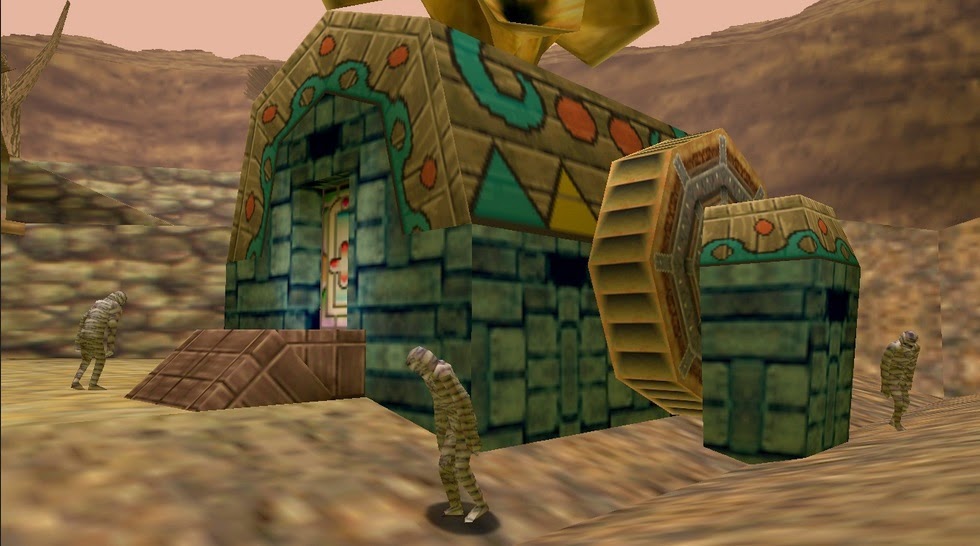
A musicbox-house surrounded by mummies... Ok.

In MM, Link encounters a weird, wooden-like forest child with a mask, called “Skull-Kid”. This little gnome steals your horse, Epona, so you’ll chase him into a gigantic tree where you would fall in a big, deep, dark hole… You must have knocked your head really hard, because what follows is a strange dream with that Skull-Kid, and next you’ll wake up inside in the Clocktower of a complete different world. Still following me? Good.

For a change, you won’t be looking for a princess this time, and Ganondorf took a vacation as well. You are on the look for your horse, but there seems to be an more urgent problem in this strange world called “Termina”: the moon is falling down!


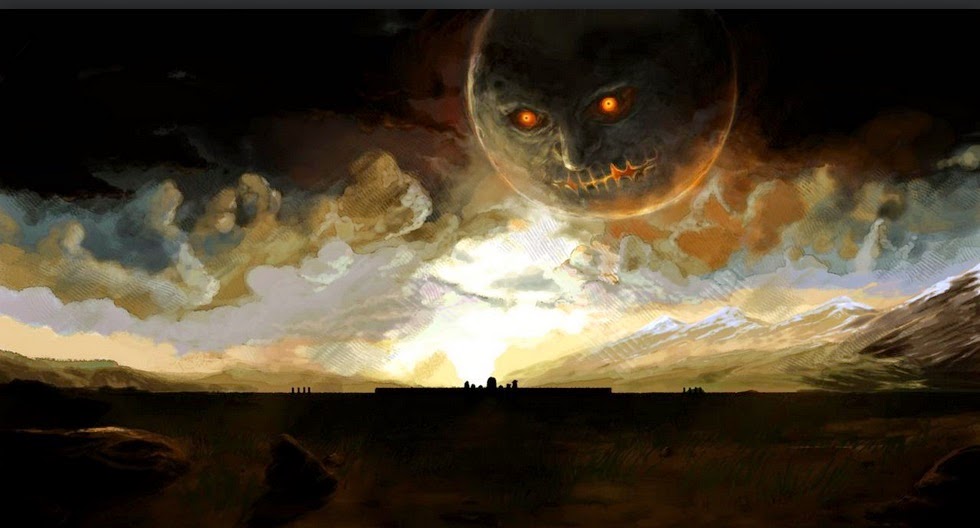
Don't know who made this nice (fan)artwork, but I had to post it.

Oh, and another problem, you wake up as a “Deku Kid”. A what? A wooden tree stump like guy that “normally” lives in the forest. Somehow you lost all your items, and even your own human body. Now what? Once stepping outside the clocktower, you’ll find yourself in Clocktown, at the centre of the game-map (or world, if you prefer). The village is decorated in a colourful carnival setting, and people seem to be working hard for the festival that starts in 3 days. But eh, how about that angry looking moon above the village? Like in a dream, most people don’t seem to be worried or even realize. Basically the plot of the game is to stop the Skull Kid we met earlier, which is bringing down the moon with his ultra-magic powers that mysterious Majora’s Mask is giving him. The moon will crash in 3 days (you can actually see the moon coming closer and closer), so basically you only have 3 days to save the world. Like in Ocarina of Time, the game has a day-night cycle but with the difference that time passes much slower, and the clock being ticking always, no matter where you are (in Ocarina of Time the clock would only tick in certain parts of the world).


Soap series
You don’t like games with a timie-limit? Me neither. But don’t worry, you can warp yourself back to the first day anytime you like with the help of your magic fluit. You’ll also learn how to slow-down or accelerate time. Everything is about time in this game, and you are the manipulator. Time doesn’t just affect the position of the moon or day/night cyclus. It controls what people are doing, what kind weather it is, and what events will happen. For example, the weather is a bit rainy at day2. The festive music changes in a more sad tune, and people prefer to stay inside that day. Another example, during the 1st day night, an old lady comes back from picking mushrooms on the fields, and gets robbed by a thief at 0:30.

Yes, you are thinking right, you can change the chain of events by interfering at the right time. If you chase away the thief, the old lady will reward you. Or help a girl finding her missing love so you can break in his house at day 2 while he is walking to his mailbox. I can’t exactly remember all side-quests, but believe me, it’s pretty brilliant and more complicated it may sound first. A big part of the game plays inside and around this central “Clocktown”, and each character in this town has its own schedule. Go to the mayor office at 14:00 at day 1, go back home at 19:00, deliver a letter at 10:00 day 2, and so on. The schedules are tightly related to certain events or intertwined with schedules from other characters. The fun part is spying on people, writing down what they, and interfere to solve quests.


Just some events at a single location, for a single character.

As mentioned earlier with Twilight Princess, bigger isn’t always better. So you don’t have to watch and remember what 100 people, scattered all over the place, are doing. The town is relative small (but has many hidden spots), and the number of people is limited. Quality goes over the quantity of quests, and the amount is just good enough to handle the situation comfortable. As said, Zelda isn’t only about rushing and action. You can hide in a bush, chill out, and just wait and see what happens. It’s exciting, sometimes difficult, but also relaxing at the same time.

Besides playing Sherlock Holmes, solving people’s problems, you have the old fashioned dungeon and adventure work as well of course. Termina Field is surrounded by 4 sub-worlds; a swamp, a snow-covered mountain, a beach & underwater world, and a spooky dusty valley. Each sub-world has its own portion of troubles you’ll learn about via conversations with the locals. The swamp water is poisoned, the mountain village is covered in an extreme snow blizzard, an underwater music band is missing a band member, and so on. By defeating dungeon bosses, the world seems to get restored bit by bit. However, and this sometimes feels a bit frustrating, all your efforts are reset once you travel back in time. Your interference isn’t permanent, except that you do keep your gained powers, found items, and collected masks.


Transformers
Speaking about special powers, you start the game as a Deku Kid, a defenceless treestump, not allowed to leave Clocktown. But it has the ability to hover in the air, crossing wider gaps. You’ll find out how to transform back to your own self again with the help of masks. You can collect all kinds of masks. Masks that make you faster, turn you into a statue, et cetera. Most interesting are the 3 masks that can transform you into a Deku Kid, a strong Goron, or a Zora that allows you to explore deep waters. And of course, these masks don’t only change your appearances and abilities, they also alter the way how people approach you. The Deku Kid is treated as a kid, the Goron gets respect, and you’re a famous rockstar as the Zora character.


As a Goron, you can smash things and quickly roll like a bowling ball.

Compared to any other adventure game I know, including all other Zelda’s, Majora’s Mask certainly has the most complex and interesting dialog system. In most games people just stand somewhere stationary, doing the same thing throughout the game. And as they barely overlap schedules or storylines of other characters, they feel isolated, uninteresting, and therefore fake. But in MM, people actually do things. I’m really hoping to see this back some day in a new Zelda, but I’m afraid this was a single-shot. You’ll have to understand that A.I. behaviour of the NPC’s is tightly related to the clock, and the fact it resets every 3 days. If it wouldn’t reset, the makers would have to make an infinite long schedule for each character, which is impossible (or makes them do fairly unimportant things).


Lessons learned – Tower22
To almost conclude this “review”, it might be interesting to tell a bit about what a game designer could learn from these titles. Tower22 isn’t exactly a fantasy game where you can chat, ride a horse or go fishing. Nevertheless, I found a lot of Zelda elements, including the Majora’s Mask scheduling system, inspiring.

What these games have in common, is that both have puzzling, exploration, and fall in the “free roaming” category. Technically, Zelda isn’t 100% free roaming either (nor is any other game) as there’s still a specific order of achievements. You can’t beat dungeon 3 without beating dungeon 2 first, and you can’t reach the boomerang object without having the grappling hook. But at least Zelda doesn’t really tell you were to go, and it certainly doesn’t restrict you from going back, as a “linear” game would do. This makes the exploration and puzzling part more difficult, as you may investigate the wrong places, or miss a key location during your journey.

I plan the same kind of approach in Tower22. You can go anywhere you want (at least, after unlocking each part), and the game won’t hold your hand when finding your way through the spooky flat-corridor maze. You’re on your own. Of course, you still can get some clues. But unlike Zelda, you won’t have too many chat-partners to get your information. So the hints have to be hidden in the environment instead.

Maybe the most important lesson from Zelda, is the way how they designed their maps. If you plan to make a game, you’re fantasy is probably filled with all kinds of wild ideas. But be careful not to get inconsistent. All characters, events, locations and structures must complement each other, and sometimes less is more. The environment is everything in games like Zelda, and the same will likely count for Tower22, where the focus is not on beating up monsters, but lonely exploring the deepest hidden spaces of this building.


The Next Zelda?
Well, if you are a Zelda fan, I probably didn’t tell anything new but hopefully I stirred some Nostalgia. If you didn’t knew Zelda, I hope you give it a try now, or at least understand the charms of it a bit. As for myself, I don’t know if I keep following the series. The games are timeless, but after seeing the same formula many times, the surprise-factor went down, and the puzzles became too easy / predictable. That doesn’t mean Zelda games are getting worse, you just can’t eat chocolate every day and expect it keeps yummy.

Then again, probably I’ll keep seeing it, as it would make a wonderful present for my daughter once she Is a little bit older. Zelda isn’t just a game for fun, it’s educative, and moreover, it’s a piece of art, culture and a lesson that will affect your fantasy for life! I’m sure it will conquer many more hearts.


Not sure what the next Zelda title will be. From what I know, the Wii-U will have some of the older titles in a new jacket though. So if you want to give these old classics a try, but are scared away by their (very) dated graphics, the Wii-U might help you. And you're helping Nintendo probably, because unfortunately their sales numbers sure have been better in the past! Let's hope Nintendo will keep delivering for many more years.

Saturday, March 29, 2014

Animation / FBX / Script kid needed

As announced in a previous post, I wanted to write a "post-mortem-game-review". But I figured it has been a while since I gave you updated about Tower22 itself. So, here a short post (and request!).

Honestly, I haven't been programming a lot on T22 the last 2 months. Mainly because of work. Doing overhours is one thing, but at some point your brain just refuses to keep switching from one task to another. It's full, and all you can do is sitting in the couch like Al Bundy, watching Al Bundy. But no worries, the extra work won't be forever. Although... some other activities in- and around our house are planned...

Anyway, to the point. The major roadblock, stuck like a sticky fat turd in the rectum. We made pretty much all ingredients for a nice new demo that will be used to attract new people, eventually launch a kickstarter campaign, and everything. If it wasn't for you meddling Scooby Doo kids, erh I mean FBX animations. God damn, what an annoyance. We successfully imported some FBX files, including rigs and animations. But the SDK changed again (of course), and for some reason Maya decides to export its files very different once using more advanced techniques such as IK or curves. It's all in the FBX file, but I wouldn't know where.

If I had a bit more time to concentrate on that bloody FBX SDK, I may figure it out. But as said, it's busy in my upperchamber, plus I just hate figuring out someone else his shit. The FBX SDK isn't just a file loader, you can reprogram the universe with it. Or something. Anyhow it's big, and I'm not patient enough anymore to figure out big stuff for just importing a freak'n animation.


If you are reading this and think "Hey, but I know how FBX works!" or "Hey, but I know how to write Maya file-exporter scripts!", you're more than welcome giving a helping hand on that! Or if you know Collada very well, we could use that instead as well.

So, basically we're chasing our FBX quest, although I'm thinking to make a temporary fix by just using MD5 animations instead for now. It's old (Doom3 era), but at least that file format made sense to me. Once we get our animations imported properly, I expect the animator needs 1 or 2 months to get his work done for this demo.


* If you use the message-form on the website but don't get a reply within a few days, please drop a note here below. The contact form should work, yet I'm not 200% sure, so apologees if it doesn't!

Saturday, March 22, 2014

Null pointer exception

If you ever tried to make a game, look at this:
AVGN: Big Rigs
Amazing, isn't it? I know, my jaw too felt on the ground. Not necessarily because of the awesome quality, but because this masterpiece actually ended up in a store, as a game, something a consumer can spend his money on. There are bad games, ugly games, unfair games, frustrating games, stupid games, dumb games, horrible games. But this jewel...

If you ever TRIED to make a game, this title should be a true feast of recognition. Like babies, games start as unfinished, incomplete, erh, chunks in a womb called your local hard-drive. One of my very first "game" experiments in Delphi, was a top-down view image where you could drive a tank on top. Or well, drive... pressing the arrow keys would simply move the tank image 1 cell left/right/up/down. There were no animations or physics such as velocity. And oh, collision detection was nowhere to be detected either. Just drive over that house dude. It all made perfect sense because A: it was an experimental piece of programming, and B: that’s what tanks do, running over houses.

Unfortunately, my "Tank" game was never commercially released. Not even after adding some sound effects when firing the cannon! Oh well, at least we learned how NOT to make a game (I just used a bunch of TImages, TTimers and a TMediaplayer in Delphi, not OpenGL/DirectX or whatsoever). As a 15 year old, I found it quite impressive nonetheless.

But seriously, even at that age I was smart enough to realize this program couldn't be considered a game, or a sellable object in general. Of course not, silly pants. The makers of "Big Rigs: over the road racing" thought different though... Apparently this game was in a box, on a shelve, for sale, in a game store. Really if you didn't click the link above, just watch for 3 seconds and then pull out your hair.


OT: We had some fun with wallpapers

Alpha Beta Gamma release
Can't judge the technical insights my hero "Angry Video Game Nerd" has, but in general people take stuff like *working* physics, solid game-logic, or even a seemingly simply main-menu for granted. If you made games yourself, you know that you’ll get nothing for free. Your premature baby doesn't have sound effects or animations. It doesn't look good at all, Access violations all over the place, and physics will go ape for sure. Even in a more advanced stage, your babies still drop through floors, get stuck in walls, or get launched with infinite velocity into binary dimensions no-one has been before. It happens because physics are hard. Making nice animated graphics is hard. Even making a robust framework to show some stupid buttons and text-labels for a main-menu takes time, and is likely to remain unfinished for a long time. And don't even begin about game-logic.

I'll be honest, Tower22 technically isn't a game yet. Because you can't win or lose, or beat a level for that matter. That sounds lame, but this kind of basic logic requires a big foundation. You can't lose if there aren't bad guys with working AI to kill you. You can't win if there is no start- and end destination. To make this working a bit, you will need a world, maps, inventory systems, enemies that can think, puzzles to solve, scripts that decide what happens when, and being able to climb a stair without triggering "array out of bounds" errors would be nice too. Some games need a bigger foundation than another. Obviously Pong or a Tennis game doesn't require complicated worlds, puzzles or batteries of enemies. Nevertheless, Pong still isn't Pong if basic elements, such as bouncing a ball and keeping a score, fail.

No worries, it's natural that games in development don't feel or even look like a game for a long period. I believe I posted this before, but just have a look at the development of Doom for example. It perfectly shows how fragile a game is. Just remove the sound of a gun, or disable the dead-animation of your foes, and the whole game suddenly feels like unfinished garbage. Walking through a wall immediately breaks the illusion of you being in a "real" world. Glitches can be fun if well hidden, but otherwise they ruin the immersion obviously.


You may remember a somewhat better screenshot of this "hydra monter" scene. Early alpha versions had poor performance, no ragdoll physics, different foes & guns, half half maps with holes, and purple water. People complain Halflife3 is taking forever, but trust me, if they would release it rushed or unfinished like this, you won't like it. Really.

Well, fortunately most programmers understand you can't deliver a half-finished product, whether that's a game or an office application. Less fortunate is that many "hobby" game attempts will stick somewhere in this early-pre-pre-alpha phase. Besides "Tank", I made quite some more half-baked games before, a long time ago. So when looking the "Big Rigs" video link above, it brought back some warm memories. Of course a truck can drive upon a 89 degrees slope. Just put the height coordinate according to the height map, and of you go! The flickering water & road polygons? Easy, just paste 2 surfaces on top of each other, so the computer precision is too low to decide which layer should be rendered first. Opponent truck not driving? Of course not. If I would make that game, I would first focus on my own truck. The timers being rendered outside the box? Pfff, who cares. GUI & HUD is easy, so I'll fix that some other day, it doesn't spoil the fun. Head light sprites misplaced? Oops, probably something with coordinate conversions or something. "You're winner!"(is that English?) after getting beat by the opponent? Meh, don't be a nit-picker. Like I said, first I want the trucks to drive, and render some cool maps.

Yep, that game exactly looks how I did a similar (3D) racing game somewhere early in the 21th century. Except that... my game was never released, nor did it have a credits-screen with 9(!) men (including a sound FX guy for making 1 single engine effect). Or a box cover, warming up the audience with features that aren't in the game at all. Man, imagine your mother bought "Big Rigs" and put it under the Christmas tree. “Boys love trucks, this game sounds excellent, and its rated for all ages by ESRB(?!!). Boy, he’s gonna be so happy!”… I feel very sorry for these traumatized families.

This game was literally just abandon like you would do with your hobby game, when getting bored 3 weeks after the start. But somehow... somehow this mess found its way to the stores. Even for North Korean standards this would be considered "unfinished" and "shit". And if you still didn't click the link and think I might be exaggerating just a little bit, CLICK!


You can count at least 4 glitches here already. And don't think this is a "lucky" screenshot, this happens all the time!

It was released in 2003. That may sound old and therefore forgivable. But to show you the contrast, 2003 also brought us Battlefield 1942, Sim City 4, Ages of Mythologies, Fable, Call of Duty, and GTA: Vice City. Can't blame bad standards or lacking hardware back then. Mind boggling. Anyhow, what intrigued me in that video, asides from that awesome game, was the definition of a “game”.

This piece of stool sure had bad graphics, but compared to Mario Kart on the SNES, it looks technically more advanced… imagine you would see this full 3D game back in 1992 (when Mario Kart was released), it would probably be the best thing since sliced bread. Graphics quality is somewhat relative. Same goes for audio. This game sounds as if the “audio engineer” recorded a single fart (at least that’s how I did it with my race games), loops it, and adjusts the pitch as the velocity increases. But then again, several Commodore / Atari / PC-Speaker era titles may have sound worse in absolute terms. And yet Mario Kart, Micro Machines, or Stunts are still much better games. Hence, they can’t even be compared. Big Rigs was supposed to be a racing game, but simply isn’t. Having a confused guy walking on a football field doesn’t automatically make a soccer game either.

That brings us straight to the core-definition of a “game”. Something can be called a “game” if it can be won, or lost. Since the opponent truck in “Big Rigs” didn’t even drive at all, the very heart is gone. It’s just a demonstration of (bad) audio and graphics. It’s like… Frankenstein, but without the magic electrical jolt that brought this creature alive.


Winning for everyone!
Funny though that modern games are slipping away from the win/lose model. You can still beat and win pretty much any game, but the “lose” factor has been tuned down, chased back into its closet. Just played a bit of Crysis 2 a few hours ago, and although I like it, it’s not really a challenge. Your whole path is scripted, you fully recover after some seconds hiding, and your super-suit protects you from barrages of bullets and other epic disasters.

But ok. At least you can still die, which stimulates to try a different tactic. Or smash the keyboard if you died 4 times in a row. An even weirder game (to me) was Bioshock. You couldn’t lose at all here. Even in ADHD-kid games such as Call of Duty, you still have to replay 6 seconds after dying. But in Bioshock you just respawn with your gear and the game continues. It may take 10 lives when trying to slap a “Big Daddy” to death, but eventually you’ll win. If it wasn’t for the quality and levels that beg to get explored, I wouldn’t consider Bioshock as a fun game. In my eyes, it’s technically not a game, but an interactive demonstration of a wonderful horrible underwater world.


As art, Bioshock is a masterpiece. As a game, I don't know what to think of it.

The opposite also happens. Did you ever beat Sim City? Or Transport Tycoon? Or The Sims? You probably didn’t. Because it’s impossible to win here. The game just goes on infinitely. You can try to improve your metropolis, or murder your Sims and restart, but there is no ultimate goal, there are no end credits. And sooner or later, you will get tired and leave the game for that reason. Yet I usually liked playing these kind of sim-games. Getting a new attraction, money to buy a cleaning robot maid, or reaching the year 2000 so your skyscrapers would look ultra-futuristic, are rewards that make it worth to keep playing. Until we went through all the rewards, and then the game gets pointless, due the lack of a final “win”.

This even happens with super titles. I always wonder a bit why the makers of GTA spend so much energy in making side activities. You can play pool, go bowling, do a boat-race, do vigilant missions, go sight-seeing, pimp cars, and the list goes on and on. But as soon as the main storyline finishes, the game gets “hollow”. No more fun dialogs or goals. What are you still doing in that virtual world? Did you know you can lay darts or ride a bike in the real world as well? Almost forgot.


Well kids. The moral of this story: make sure your game has rewards, challenges, win and lose conditions. If those elements suck, your whole game will suck regardless the quality of sounds or 3D assets decorating it. Next, spend time on play-testing and finishing things. It's better to reserve more time or eventually shorten your game, rather than delivering unfinished features. Doubts and bugs that may look small in your eyes, are magnified 100 times by the end consumer. Oh, and finally, buy “Big Rigs”.

Sunday, February 23, 2014

Game Gods

Old mcPhart

As if it was only a few years ago, I can clearly remember how my little brother and I joked and always called our dad "grandpa", to tease him. All people somewhere above 35 were called grandma or grandpa anyway. Old people who grew up with the Beatles in the black&white era, getting bold, without much fantasy anymore, reading a book or falling asleep instead of playing with Lego or Nintendo. Complaining about rules, school and "wait till you're a little bit older!". Yep, grandpa-symptoms all right.

My daughter is getting near the age we used to be when calling our parents old and crippled. And although I became a father relative young, I also passed the 30-years border a few days ago. It's just a stupid number and usually I couldn't care less, but at the same time you do realize that "fun-time is over". Not entirely true of course, but looking back, it's just statistically true that:
- aged 0..4: the "dark shit" ages
No explanation needed.

- aged 5..10: the magic ages
The world looks, feels, sounds and smells like magic. All very new. Sometimes scary, sometimes beautiful. But mostly pure, and without much care. That's why everybody still loves you.

- aged 10..18: the "experience" ages
Turbulent times. You develop your character. You know everything better and despite your parents telling smoking is bad, drugs are bad, alcohol is bad, and girls stink, you do it all anyway. Screw them. And if you can't win with arguments, you cry and yell like, exactly, a spoiled teenager. The world is about you.

- aged 18..30: the "getting mature" ages
My first job! My first school degree! My drivers license! First time getting a man with a woman in bed! First illegal house party! First vomit over your friends shoes! First keys from your first house! First baby... We had fun all right. But moreover, unless you screwed up really bad in the experience ages, the puzzle pieces should fall together now. Hey, you're growing up finally!

- aged 30+: the "getting older" ages
Yeah... what to do now? At this point, you probably experienced and learned most essential life lessons. You climbed to the top, watched over the landscape, smiled, and now decided to go back and settle. Stability is what you're looking for. You know who you are now, you know your limits, you know there won't be much more drastic changes or milestones to come. You start realizing "this is it".

- Aged 50+: the "complain" ages
Back in the days everything was better. People were more friendly, women less slutty, kids smarter, politicians more honest, cars more shiny, folks less greedy. You miss those days. And who to blame? Exactly. The youth of course. But maybe what really bothers you, is the inevitable fact that you're losing your skills, charms, looks and vitality. Quick, buy a sports-car or do a parachute jump while you still can.

- Aged 70+: the "wise mummy" ages
You had the privilege to reach this age, and hopefully you can watch over your little empire of ((great)grand)children. You're anything except like a teenager, apart from the fact you got stubborn again; people won't teach you or tell you what to do anymore. Been there, done that.

I'm quite good in making things sound a bit more dramatic than they actually are. But honestly, I'm a happy man blessed with friends, family, a good looking & caring woman, a healthy kid, a house, a job I don't mind doing extra hours for, and an environment that doesn't explode like you see on the news channels. It could have been a thousand times worse. I'm not a believer, but I should thank God anyway.

It's just that I'm aware that things won't get much better than this anymore. There is a difference between evolution and revolution. From now on, things evaluate, hopefully with a positive trend. But you can't get drunk for the first time anymore, or feel the same sick making love you experienced your girl X years ago. Your next house will be a step forward, but you already know how to wash your own underpants. And worst of all, a new video game under the Christmas tree won’t get you over-excited anymore…


Off topic, Julio made a poster we'll be putting on a nearby school (hopefully) soon. Let's see if we can catch a few talented students with that! Oh, and if you guys like this poster, I can post or send you a big-resolution version as well.


The "Getting older" ages
Speaking of games... Every boy born after 1980 has a list of favorite games. We grew up with Nintendo's, Sega's, Playstations, Amiga's or the PC otherwise. And if you don't have a list of favs because you dislike gaming, you’re probably not reading this anyway. Shoo! I make an exception for girls, as they may found serenity with games somewhat later in the timeline. Girls + games = not cool, at least that is a label designed by women themselves. But it seems more and more girls set aside their image and just learned to enjoy games. Unfortunately my girl missed the boat, but damn sure I will play Double Dragon with little Julia as soon she is ready! Her hands aren't big enough to hold a controller so far, but time and vegetables will heal that.

As explained, my listing of favorite games doesn't grow much anymore now that I reached an age we would call “grandpa” in the past. Though I was pleasantly surprised with the brilliant "Advance Wars" (GBA / NDS) series and Red Dead Redemption not long ago. But all in all, the lack of time and age are making it hard to get truly charmed by a game. When picking up a new Zelda for example, I can't help but thinking I've seen the same puzzles, items, characters, worlds, music and ideas (too) many times before. Stories change, but the core is still equal to the SNES and N64 versions I first played. GTA V was fun, but I naturally started comparing it with "San Andreas" (one of my favs), and concluded I'm not getting transformed in a wigger anymore, listening to nineties ghetto rap and spending the evenings with my little brother on the attic playing this game. The impact was much smaller.
Nostalgia is something you can't buy.

And there is (the lack of) time. During days, I can't play violent stuff with kids around. During the evenings, my girl steals the TV for Polish soaps and other excrement. During the nights, well, either I program or sleep then. So what happens with long and complex games such as GTA or Zelda, is that they get fragmented in small bits over week or months. Sounds more durable than paying 50$ and finishing the game two days later after 48 hours non-stop action. But with such random intervals, you continuously forget the story plot, what you were doing, and you won’t get "sucked in". I still play games, don't get me wrong, but usually I pick the older ones that are easy to boot up, play for 30 minutes, save & shut again. Like eating fastfood instead of reserving a whole evening in a star restaurant.

Last but not least, there is no-one to share the experience with. As a kid, you'll draw Yoshi with your classmates. Friends came over to see Command & Conquer on your brand new turbo Hertz 486 PC, and also on a later age, we used to play games like Resident Evil together, making jokes about zombies, ridiculizing the plot (and play tough to mask our fears). But those persons are gone, gave up gaming, or can’t join you on a regular interval anymore. My big girl doesn't like games, little girl is still too young, brother doesn't live in the same house anymore, and friends are busy as well. All the hope is on my daughter. But until then, let's try to keep the vibe by at least not forgetting all the good times we had in the past.


"That little guy almost moves like a real human!" my father said, astonished.


All-time-favorite Post Mortem Reviews
In the next months (or years?), I'd like to commit some topics on my all-time-favorite games. I know this blog should be about T22, and there are plenty of (classic)game websites already. Then again, there is less to post about T22 because either I already told you about it, and in some stadiums there is just not that much to share. Either the progress is slow, the content not very interesting, or the new work is classified "top secret". But moreover, in my case games influenced my "Magic" and "Experience" ages quite a lot, and that experience is also applied on Tower22. I didn't study programming to make boring databases obviously!

Besides, I always wanted to write a game review, so why not? Long before the stupid idea of becoming a "game programmer" settled in my head, I wanted to become a reviewer for a games-magazine. Hence, even now I still review games in my head when cycling to work. What else to think of those thirty minutes every day? So, just for the sake of finally executing this little-boys-fantasy, let me have it my way. Pleeeaase??

Good. To make the (post)reviews slightly different than the billion others out there, I'll try to give them a slight game-design twist, as I always looked very critically to games. I didn't just play & enjoy them, I saw them as competitors (imagining I'd be making my own games) and analyzed the good, bad and ugly of games. Though I missed most of the very early game stations (Commodore, Atari, NES), I also saw the evolution of games. Or revolution, when comparing the technical leaps between Tetris, Wolfenstein and Crysis. Sure, games and hardware still march forward these days, but not as spectacular as they did in the nineties and early 21th century. Man, I played “Air Borne Rangers” on a PC without a harddrive, California Games on a monochrome (green - black) screen, and stared with open mouth to the super smooth animations of Prince of Persia, which was displayed in a shop window somewhere during a cold Christmas in 1990.


8 bit eye-opener
Well, I won't review anything in this topic yet, but I'll finish further with my own history in games. Our first computer, a XT-something, arrived when I was six. Ironically, my father didn't know shit about computers yes, so my mother gave the great advice of buying a system without a hard-drive. Everything was on floppies anyway she said. Mom did a typing course somewhere in my Dark shit Ages, so she had all the experience. Well, the roles quickly changed, as mom never used a computer until recently (internet shopping, of course), and dad found a new hobby in it. I didn't -and still don't- understand what dad was screwing in the BIOS and such, but it sure looked interesting. The seeds of "doing something with computers for a profession" were planted.

However, this piece of hardware wasn't used as a game-computer yet. My interest was still in physical toys such as Lego or Minitrix trains. Hence, I barely knew you could play games on a computer. We used the XT for typing crazy commands, and learning what a computer IS basically. No, my eyes really opened one or two years later, when coffee-visiting a girlfriend of mom. Her daughter (what did I say about girls & games?!) was playing Super Mario Bros. On a Nintendo 8 bit. I remember seeing commercials of Zelda (had nightmares about a lion and a sleeping princess for some reason), but I never saw a Nintendo in action. Nor did I heard of the "Platform game" concept. It was totally new, and man... it was awesome. Everything about it. The colors on the TV, jumping a fat little red guy, the joysticks, the orange Zapper gun. As soon as we got home, I started to make my own Nintendo... made of the Minitrix train box with a transparent front, and a drawing of the 2D Mushroom Kingdom that could roll by inside this "TV". Making a jumping character turned out to be too difficult for this little boy though.

You can guess what “Sinterklaas” (our version of Santaclaus) red on my wish-list. Unfortunately, the finances didn't allow Sinterklaas to buy me a NES, nor the Sega equivalent. Strange enough that some other friends actually did get a NES. Sinterklaas can't love every kid equally of course. Anyhow, I picked up more and more bits of this thing called "games". I bought Nintendo magazines, and father also figured out how to play games (from diskette or Floppy) on our already dating XT computer. This is how we met California games, Jungle Book, Pac-Man, and Air Borne Rangers. Yet, those games didn't match what I saw the girl doing on the Television with Super Mario. Nintendo was the shit, and every kid in the street had one. Except us of course. History would repeat with Doom2 btw, when I had to wait more than a year before the PC was finally upgraded.

We did borrow a Nintendo for a week one time. Younger ones may not remember, but back in our days there were stores where you could borrow VHS (movies), games or even game-consoles for some days. So I finally had my temporary Nintendo, with the even more awesome Super Mario Bros 3, and some kids in the street also gave my some games to try. Still remember how "Boom Boom" flew out of the screen and didn't return, a classic SM3 glitch. Mom must have observed closely what happened to her son, before getting one of those addictive things in house.


Super Buy
To help Sinterklaas a bit, I started to collect "5 gulden" (~2$) coins that year. And hindsight, it was probably a good thing to skip the NES, because the commercials started bombarding us with the Super Nintendo (SNES), Super Mario World, and Super Street Fighter. Believe it or not, but we recorded these commercials on VHS so we could watch the movie of Mario passing those super sized ceiling-drills over and over again. Those gamepads had 4 colored buttons instead of the 2 red buttons on the NES! Imagine what you could do with that! My little brother and I were sick of jealousy when a woman had to pick prizes in "Wheel of fortune", and chose a SNES. Not for her, but for her nephews. Fuck, why didn't we have an aunt giving us a Super Nintendo? The world can be so unfair.


Forget all other toys. This box and its large grey "cassettes" stood for endless fun. Those who waited for a SNES, probably still get tinkles when seeing this.

But, after collecting coins and saving all birthday money for a year or so, Sinterklaas came again. In the early morning of 5 December 1992, a big box was waiting on the chair. Finally! A Super-... box of electrical heated mattress sheets?!?! What the hell did Sinterklaas do?! That kids, is how my mom made a priceless photo of her 8 year old son almost dying of misery that morning. Mom and dad had electrical mattress sheets, and I remember once saying I would like to have one too. I unpacked the few other small packages, but obviously this Sinterklaas-party was ruined.

"Did you already open the box, Rick", mom asked? No, of course not. But ok, I'll do... and then the 4 shiny red-green-yellow-blue buttons of a SNES gamepad showed up behind the cardboard. The bastards just packed the SNES + Super Mario World in an their old box. The next photo in the album shows a happy 8 year old. Now I played with power, super-power. And then the photo album ended because their son wasted the next 20 years behind a computer. Thinking about it, I wonder if I can ever make Julia THAT happy with a present. The little girl already has everything. I know, don't spoil your kids, but yet it happens.


All right, with that piece of history explained, it's obvious that I'm a "Nintendo" guy. Not a surprise that quite some games in my favorites-listing come from Nintendo. But not much later, the PC got a more prominent role in our house as well. It still took a while before the harddisc-less XT was replaced with a 286, but certainly when the holy CD-ROM came, the PC proved to be more than just a spreadsheet machine for nerds. I'll sure fall back to more exciting PC hardware stories in the upcoming reviews, but let's end this post with my global computer-timeline:


And as the games I'd like to write about somewhere in the next months/year, here my top 10 favorites plus a few more that are worth noticing. Note these aren't the releases dates, but when I approximately met these games

Saturday, February 8, 2014

Light-shafts, take #3

Wasted another weekend on bloody light-shafts, aka volumetric lighting, aka volumetric fog, aka fake shit to pimp your scene. These effects have been in the engine for ages, but when it comes to graphics-programming, your code is always out-dated. Especially when you left it unfinished (and you know finishing things 101% in the programming world is near to impossible). Some pesky little errors remained, you were too lazy to fix them, and one year later you have no clue what is going on so you'll decide to just redo the whole dang thing.


This doesn't look too complicated, yet it's pretty hard to to draw a volumetric beam if you don't have any polygons that catch light.

Anyway. What's up with volumetric-stuff then? For those who don't know, even though we have 3D games for two decades now, we still suck at rendering *everything* in true 3D. Solid walls or octopus monsters no problem. Fine-particle-based things on the other hand... dust, clouds, farts, fog, mustard gas, smoke, you name it. The problem is that you can't really model those things. Unless your artists are willing to make micro/nano sized particle clouds, and your computer willing to handle huge quantities of tiny “points” in a physical correct way. Nope, the level of detail is way too big, so we fall back on simple hacks to fake such phenomena.

For example, if you look at a lantern during night, you probably see a halo around the lamp. Especially if it's foggy or rainy. God didn't place billboard sprites on street lanterns though. It’s just physics minding its own business. Light rays collide with (water) particles in the air, water breaks (refracts) the light, and you see halo's or even rainbows. If you took attention at physics class, it's not all that hard to understand. But teaching your computer correct physics... There is simply not enough firepower to render on such a fine detail, store all that info, or treat light as rays in general. So instead, we just draw a transparent halo texture and put it around a light. Fixed.

As I'm getting a bit older, I learned not to always pick the hardest and most ambitious paths. If it works, it works. Clients usually don't care how brilliant your code is, and in the end most stuff you see is getting more and more fake anyway. Movie actors spend more time in front of a green screens instead of making an actual stage, soon my 5 year old daughter will Photoshop herself to a 18 year old supermodel on Facebook, mcDonalds meat isn't really meat, and I learned the dinosaurs in Jurassic Park weren't actually real either. And game-graphics are everything except a correct physics lesson.


Some effects can be simulates pretty easy. Others are more complicated. Most modern games have scenes where the sun casts beams through a forest-roof, or where dust appears behind a window as light falls in. Hence that already happened in N64 games probably. Of course they didn't actually render microscopic dust particles. The 3D artist just made a transparent box-shaped volume behind a window. That trick wouldn't work well for a forest though, as you would need to model dozens and dozens of leave shaped "pipes" in your scene. And if the sun moves, all those pipes had to be adjusted as well.

Luckily we found yet another cheap trick to fix that. Wouldn't run on a N64, but a somewhat modern computer should handle it with ease. The idea is to render the sun and maybe a darkened version of the skybox into a (small) texture. Then next step is to draw a screen-filling quad, where each pixel fires a ray towards the sun (it's 2D screen coordinate). For each step towards the lightsource, accumulate the color from the texture made in the first step. Basically it's a reversed way of smearing out blur streaks from a bright spot on your 2D canvas. More details:
Volumetric light as post effect, nVidia GPU Gems 3


Works well for one or a few dominant lights in the background. Doesn't work too well if the lightsource isn't visible directly. Huh? If you walk through a corridor, you might see sunlight falling through the windows, but without seeing the actual sun itself. As soon as the lightsource gets occluded or when you turn your back to it, it won’t get rendered on the input-texture. Thus there is nothing to blur / smear out, and this no lightshafts either. For example, it wouldn’t work for the scene in the picture at the top of this article; the viewer can see the light beam, but not the light that casts it.

To fix that, yet another trick came by. Nothing new either, although games may still not use it on a wide scale because it's a beefy effect. The idea is that for each pixel on the screen, or at least for each pixel that overlaps a light volume, you send a ray forwards. This ray might intersect the light-volume at some point. If it does, you accumulate a color. To make the effect more impressive, you can test whether that particular point in space wouldn't be shaded by using a shadowMap. This is obviously the more advanced effect, but it takes a lot of sampling, and requires a shadowMap to become really cool.


A basic explanation. It seems more advanced, optimized versions (less sampling) have been made in the meanwhile by smart guys. I didn't read it yet myself, but:
Intel GTD Light Scattering

Well, problem solved, didn't we? Hmmm. I thought so a few years ago when making these effects for the first time, but I always had problems with performance and flexibility. In my screenshots, such effects usually look quite nice. But in reality, when moving around in the scene, the effect could become barely visible or way too visible. Since it's hard to predict how many samples will accumulate light for a certain point of view, the results can vary quite a lot. After some shader- tweaking it would usually look better, but blow up again in a different scene one month later. Or adjustable parameters were hard to understand and still didn't achieve the desired results.


On the bottom-left buffer it seems pretty cool. But in-game it looks as if a honey-bear took a dump in the chandelier. Balancing problem.

Maybe the real problem is that the techniques above are fakes that can only cover one particular effect. Whether to use them or not really depends on the situation. For example, the effect above works for making a color or dust particles INSIDE a lightbeam visible. But in my dusty T22 corridors, I basically need dust everywhere, thus also in area's that aren't directly lit. I would need to complement the effect described above with another one. For example by filling the whole area with dust-sprites that slowly fly around.

The point is, each situation differs and asks for different techniques. Sometimes advanced shaders, sometimes cheap tricks that your grandpa invented already. Being ambitious (and younger), I tried to make a single multi-functional shaders that would solve all my "volumetric needs", but that didn't work out. Way too much overhead, too little artistic control, and tweaking it was like Jenga. Insert a block to improve effect A, and it will screw up effect B as another block falls out on the other side. So, I decided to disassemble again into multiple, simpler effects again. Let the artist decide what is needed for scenario X. It feels a bit unnatural though. Game engines try to solve more and more graphical issues with realtime, dynamic, uniform "super-shaders" rather than giving a bunch of dirty tricks.


I wonder how modern engines like UDK or CryEngine deal with this. Does the artist just click a button to get instant-awesomeness (whether that is a volumetric fog field, nice lighting & G.I., or a reflective flooded scene), or does it also involve a lot of parameter tweaking, masking ugly corners, and messing around with multiple techniques to see what works best? It's easy to get fooled by screenshots or carefully scripted movies. Like I said, I've become Goebbels when it becomes to showing you the better looking parts of the game. And so are they.

Well, after the latest adjustments, I should be happy again with the volumetric effects for about 3 months. Then I probably get jealous again after seeing a picture or game that seems to do it in a better or smarter way. The graphics-programming lifecycle in a nutshell.

Saturday, January 18, 2014

The art of being a 3D artist

Still here in 2014? Good. I had some difficulties finding a topic to write about. Not because nothing happened the last weeks, but I mainly wasted the free hours on modeling maps. Unless I was a very skilled environment modeler, I can't tell you too much about it. Or well, maybe I can.

To start todays story, I’m thinking about contacting a nearby school that provides a games-study (NHTV Breda). With the hopes to find some 2D or 3D students, or maybe other interesting contacts. I’m afraid I can’t offer a place for interns though. At least, you’re welcome to sit down in my house and drink coffee with my girlfriend, but I won’t be home to teach you things until night. Nor can I introduce you to the games-business. Nevertheless, I think beginning artists should grab any chance to learn and practice their skills. If you’re too lazy for that, then forget about your career as a game-developer. You will need to bleed to achieve something sonny boy.

I’m not too worried about finding enthusiast students (at least if the school cooperates a bit). I’m more worried about their skills. With some exceptions, you simply can’t expect too much of young people who just started to explore the wonderful 3D world. Especially not if you’re a cheap asshole like me that can’t pay them. But with some energy and investment, your student will develop & grow. But at the same time, there has to be at least some degree experience and skill before I can let you enter the ship.


The Idea-maker, the Brains, and the Muscle
----------------------------------------------
Last years, I've seen quite some models from various modelers. Obviously, there is a big difference between artists. And not just quality wise in their demo-reels. Like building a house, multiple professions must be combined. There is the idea-maker, the creative architect, whose job is to draw inspiring sketches and dares to think out of the box. We have the brains, who tests if the floating-block ideas won’t collapse due the laws of physics, and who can label dreams with a realistic price-tag. And of course there is the muscle, the construction worker who does the dirty job, carrying bricks through the mud, and masters his toolbox.

In 3D worlds, especially with games, these professions seem to overlap more. Although certainly not every 3D artist masters all the bits, unfortunately. I would consider myself as “the brains”. I know how to make a model that technically matches with the game engine. But I lack toolbox skills to make more advanced models, nor are my architecture skills very strong. I plan and work out most of the environments, meaning I draw floor-plans and decide the “flow” (player starts at A, goes to B, has to activate an elevator at C, shit happens at D). Usually I have a global theme, say the environment has to contain wood and an “moist orange” atmosphere. Which often comes from some random fragments I remember from dreams, a movie, or just from the streets. You see a floating copper ball, or accidentally hit a messed up photograph while Googling around. The grey matter stores it, and later on you decide it’s suitable for building a game-environment around that idea.

Only problem with me is… this happens too randomly, too fragmented. If someone asks me to squeeze out an idea, I can’t think of anything, like a dog can't shit on command. Plus I miss detailed background knowledge to form ideas. Starting artists often forget that having this “idea database” is crucial. Art isn’t only about knowing how to hold your brush. It’s the talent to throw up the right ideas at the right time. Absorbing details from stuff you see, hear and read in daily life, as well as studying things you wouldn’t normally see, is an important part of the job. You can’t be creative if your head is hollow.

Fortunately, the games industry has drawers or concept-artists for that. A 3D artist doesn’t necessarily have to come up with super ultra funky wacky crazy plans. Yet -and this is where you can separate artists quickly- you still need some ideas from yourself to fill up the small gritty details. A concept artist can’t draw each and every corner of your game. As the name sais, he or she makes a concept, brain-food, an idea to build further on. Not an exact “here-this-is-what-you-do” task list. The concept artist draws one or a few (main / vista) locations from a particular environment or area. A game however contains a dozen more rooms, corridors, or open spaces placed around those proposed vista’s.

This is where the 3D artists has to help himself, adding (small) details to keep the environment interesting. And to do so, you still need your idea-database, otherwise you’ll run out of variation soon, or fail to add a little extra touch to your environments. I experienced that 3D modelers often have the technical skills to make X or Y, but not the additional Z; they need steering from drawings or comments. That’s ok, although it works faster and better if you have those ideas locked and loaded yourself of course.

The canvas content only has to look good once. The rest of the corridor around it has to keep looking good for a much longer time, as it fills the game environment.

Unlike static artworks that can be finished with a single powerful picture, games have to repeat themselves a lot to reach X hours of gameplay. Tower22 has old plastered corridors and apartment rooms all over the skyscraper. Doom has sci-fi corridors, hanging cables + pipes and engine rooms all over Mars. Far-cry has palm trees and shacks all over the jungle. GTA has asphalt, houses, flats and factories all over the fictional city. Last of Us (nice game btw, bought it for Christmas) has decayed buildings and apocalyptic alleys all over the devastated world. Whatever your setting is, expect to make the same stuff an annoying amount of times. If you don’t really know how a tropical rainforest looks like, you quickly start failing to keep your Far-cry jungle interesting or "real". If you never paid attention to wallpapers, ornaments, woodcraft, concrete cracks and dusty wooden furniture in Victorian style houses, you won’t be able to make a whole package of Tower22 (or Last of us) corridors.

I’ll try to pay attention, but my problem is that the grey matter does a bad thing storing things. Lots of Access Violations and broken SQL queries when I try to remember something. At the same time, being creative and “out of the box” also means you can make less obvious links. If I say “old house”, you and me think about damaged walls, glass and wood splinters on the floor, dark attics, That 70s Show furniture, and blinded windows. Of course, that’s how we learned to categorize things. But it’s too obvious and simple to surprise another. An artist may think about pink elephants, boobs, Bill Cosby, or Russian submarines when I say “old house”. Something went wrong in their database search, and most ideas probably lead nowhere. But 1 “Eureka!” can be enough to give your otherwise boring environment an unique taste. It’s a (weird) skill some people have, and most don’t.


As for the technical part, this is where 3D modelers won't always pass the test too. Especially not if they don’t have experience with making game-content. Fortunately this skill is relative easy to learn, although it strokes the technical/logical Beta side of the brains, that creative Alpha guys often miss a bit. Making a 3D scene in Max, Maya, or whatever package, provides you a lot of freedom. It doesn’t have to obey polycount limits, or provide playable space, meaning it works with the game-physics or A.I. And in the end, you only have to care about your final screenshot. What happens behind the scenes, behind the camera, or from another perspective in the same scene, isn’t important. People are gonna judge the final picture, nothing else.

Quite a culture shock when moving over to games. Suddenly you’ll be told that the doorknob has way too many polygons. The way how the UV-coordinates are made can’t be imported in the game. All the vertices have to be nicely welded to avoid thin gaps or holes in the scene. The stairs are too steep to climb in the game, and the passage too narrow to let the monsters pass. All the tiny electrical wire models have to be replaced with decals. The floor mesh has to be divided in smaller quads to enable Vertex Painting or other per-vertex shading techniques you never heard of. And prepare yourself to make normalMaps instead of adding polygonal details.

Yeah...old wallpaper...? Don't be fooled, it's quite a technical mixture between poly-friendly modeling techniques to create holes, and Vertex-painting to mix several layers of diffuse/specular and normalMaps to avoid the same wallpaper repeating over and over again in those long boring corridors.

As said, the professions overlap more. A good 3D artist has to be able to come up with ideas (certainly in T22 where we don’t have an army of concept drawers and repeat a lot). The artist has to use his modeling skills, but also approach the task from a technical perspective; how to keep the polycount within limits? Can we repeat assets to reduce the amount of work? Which available techniques can be used to make the scene look good from all possible player perspectives? The 3D artist has to be both the creative one, and the brains.

And in the end also the muscle of course. Making ideas is one thing, executing and finishing them is another. I always get bored of the model after some hours. Probably because I’m not a real modeler, but finishing stuff is just a hard thing to do in general. As a kid, how many things did you started? Lego cities, comic books, tree houses, decks of magical cards, music tracks, rabbit cages, pimped cars? And how many of those projects did you actually finish? Exactly.


Patience and discipline to finish your task is yet another skill a 3D artist needs. All in all, quite some requirements. Making ideas, knowing the technical (engine)rules, being able to draw textures, absorbing ideas and studying work of others, mastering your 3D packages. If you have the right attitude, most of those things can be learned by practice I think, but it will take time and devotion.

To come back at the “acquiring students” topic, I wonder what they could offer. I’ve seen young guys that lack experience, but quickly catch up because of their talent and will. But I’ve also seen guys that, despite years of 3D package experience, just couldn’t come up with good ideas, add a bit extra love in their work, or had the ability to make a technical correct model. As said, I can’t expect too much in my position, but if I’ll have to explain and correct every task someone does, it only slows down the project. Plus it’s frustrating for both in the end. Ah, good artists. I wish you could grow them in your garden, but that’s not how it works. Got to keep my eyes and ears open to find them, and help myself with making models for the time being.