Tuesday, December 13, 2016

Ten programming hints. For Christmas (part1/3)


Although this blog is about making a game, and then mainly the nonsense & technical aspects of it, I rarely write purely programming articles. Because I think (but I could be very wrong) half of the readers doesn't really have a programming background to begin with and well, it's hard to make a readable story of bits and bytes.

But maybe some of you programmers are curious how I deal with certain things. In case you'd like to make your own game or engine someday. Or beyond that. Everything we learn while making games, is also valuable in other programming-area's. Writing clean code for example, or caring about performance / efficiency. Or when starting something *bigger*, whether that's a communication library or database + various tools, game-engine design strategies can provide priceless background knowledge.

This topic is so wide and abstract that's it hard to explain from A to Z, so instead I just grabbed ten "Programming Advises" from the top of my head, that can be applied on game-programming but also on pretty much else.Being a bit long for one post, I spreaded this over three posts by the way.
 
1. Don't be over-ambitious. Expect to start over. Many times.
2. Picking the right programming tool
3. Eyes and ears open, keep in the game
4. Efficiency versus Readability

5. Readable code // Commenting
6. Keep it small, Size matters
7. Resuable code & Modular design

8. Multi-Threading, be Multi-Carefull
9. Debugging. Don’t blame your computer. Even if it did it
10. Be consistent

1. Don't be over-ambitious. Expect to start over. Many times.

Unless you're making a small or very to-the-point application, code tends to become a proliferation of patches, added stuff, side-routes and fixes sooner or later. Eventually to a point that the code skews like the Tower of Pisa. Keep throwing weight on it, or restart with a clean sheet?

I restarted Engine22 almost two years ago, and although I've surpassed the "old" (nameless) engine on several areas, there is also a lot still missing. Doesn't matter as long as you're hobbying, though for work-related code, your chief and users are probably less excited about a reboot. Which is why people tend aim for "the ultimate code", raising the bar way higher than they can jump.

There is no such thing as "perfect code". Everything will crack at some point. It's impossible to anticipate on every possible future request, new-technique, platform or trend. Also, as you get other work, projects or hobbies over time, the dedication and deep-knowledge level of your own code will decrease. And moreover, your current skills are simply not as good as they will be over four years.

Trying to get better is a healthy ambition. Trying to do the impossible will bring you nothing but stress, frustration, an unclimbable wall of work, and eventually quitting. I restarted my game-engines (also prior to the whole Tower22 adventure) multiple times, and also approach projects at work very different each time. But I don't regret that past "wasted" work. If I didn't attempt to, I wouldn't be at my current level either. Learn by doing.

Big Bang Theory.


2. Picking the right programming tool

Long discussion short, -not trying to start any flame wars here- just pick whatever you're comfortable with. I remember fellow students telling all those Fisherman Tales about Delphi being slower because of some non-existing virtual machine, Java compiler being more clever than C++, that the Nintendo is three times faster than the Sega because of 64-bit displaced-shadow-fog matrix techniques, and so on. 10 opinions, and 9 of them are based on the opinion of somebody else, who heard something from yet another guy, which interpreted some-other-paper wrong. Not that the word of another is useless, but if you want to know things, don't forget your own research as well.

I would be lying if I say all tools are equally good. Functional-programming, Java, Eclipse, Linux... they all give me the shivers. I think HTML, Perl, CSS, JavaScript and everything involved in making websites, is a big collection of donkey dung. But that doesn't mean you have to hate it as well, and it doesn't mean you can't make awesome websites with it. Some prefer blondes, other brunettes. I prefer Delphi. And Qt. And Visual Studio. And... Doesn’t matter. What matters is that you use the tools you like. Because chances of success are simply higher then. Especially when you are still in the learning/student/hobby phase, actually *finishing* something should be considered a great success.

Don't forget the end-user will judge end-results, not how you got there. And as told in point#1, there is always time to evaluate, retry, eventually with another tool, and sharpen your skills. A bit more on this in point #5. 
When needing a CV next time, I'll use this picture.


3. Eyes and ears open, keep in the game

In addition to #2, one warning though. Do not bite into a single tool and swear on your mother’s grave you'll never switch. Stay open for other languages, programs, environments, ideas and approaches. Delphi is great for making desktop applications (and I admit, less great for games. Not because it can't, but the community behind it is thin). But not so great for making an Arduino microcontroller, or a webserver maybe. It simply can't do everything, and that counts for pretty much any tool.

Like a handyman, you'll need a well-filled toolbox. Hammer & spikes for woodcrafting, welding torch for metalwork. If there is only Visual Studio in that toolbox, you won't be prepared for all jobs. And the only way to fill that toolbox with GOOD tools, is to explore and try them.

Also don't forget that tools won't last forever. As I experienced with my beloved Delphi7, the world goes on. 64-bit? Telephone Apps? Cloud-based development? Touchscreen-Gestures? Raspberry Pi? With Delphi7, there is nothing you can't do really. But I felt I was falling behind more and more. Interns fresh from school would suggest to use Azure... Azure? That's that Caribbean beach right? Right...? No? Stupid intern. On your flying hover-board with self-lacing shoes...

I'm almost 33 now, and in some ways aging will make you wiser in a charming, George Cloony way. But I also feel it's getting harder to keep up, even though I'm not THAT old. As a Delphi Veteran, I would quickly have my opinion about all those new marketing terms. Internet-of-Things. Big data. Cubic databases...what the hell... But honestly I often have no clue what they are. So keep your nose outside for some fresh air. Not everything the intern brings in, is new-age nonsense. In fact, I enjoyed my trial Azure subscription quite a lot last month.

 
 Hahaha. But really. My "little" 8 year old girl never saw a fat CRT TV. Or a dial-up phone. Or a medium tower PC. Or a NES 8-bit. If you live in or nearby Belgium, take your kids to "Bokrijk" in Hasselt one day to go back the seventies, sixties, or far before that. Nostalgia.

4. Efficiency versus Readability

To the Bit-Mobile then. Having some 1kb RAM Microcontroller background, I always try to use optimized code. But hold on, I'm not talking about replacing everything with Assembler instructions, or squishing 20 lines of code into 10. A common mistake is that people heard something about optimization being important, and then raping their code into an unreadable mess.

The truth is, there is a 95% chance that your target platform is NOT a lousy microcontroller with 1 KB RAM. And even if it were, you are probably doing a relative simplistic sensor-measurement or robot/machine operation that doesn't require tons of resources then. Modern developers may say you shouldn't worry about resources at all. Just make your program, then optimize. If needed at all.

I half agree on that. Well (readable) written code is much easier to optimize, but probably more important, robustness weighs more than a buggy application that runs 5% faster. Highly optimized code is very sensitive to mistakes. Then again, I do think the modern programmer got spoiled with the powerful hardware we have today, and therefore has little knowledge of what happens under the hood of their muscle-car. As a result, they manage to make memory/CPU hogging monsters. Tower22 consumes ~450 MB at this point. Google Chrome with a few stupid webpages a gigabyte on my computer. Hell, pretty much any tool in the task list consumes at least 200 megabytes. And the start-up/load times are terrible as well. If I click the green "RUN" arrow in Delphi, the Tower22 world shows up within a six seconds or so. Then what the hell is taking Paintshop Pro X8 so long to boot? Something stinks here...

Efficient code is not something you'll add afterwards a bit here and there. It's a way of thinking. Knowing what kind of booby-traps we're facing. Your alarm-bells should ring when dealing with:


·         Loops - especially the long ones
Really needed? Can we shorten the loop by skipping items that don't need to be drawn/searched/updated at that time? Spread tasks over time?

               
·         Searching - (get itemX from a big list/array/collection/database)
Try to avoid anything that can't give a positive result anyway. Use grouping, sorting, caching, binary trees, or whatever suits your situation best.
               
·         Reserving many or large chunks of memory (arrays, bitmaps, ...)
Really needed all the time? Can multiple users share the same source? Worth some compression?


·         Heavy duty tasks
Avoid multi-threading if not really needed, it’s a source of headaches and hard-to-debug errors. BUT, if your main process is stalling because of big files to load, complex searches, or waiting-for-input, consider multi-threading.


Obviously, a game is doing LOT's of stuff, EVERY cycle. Drawing thousands of items, playing sound, calculating physics and collisions, updating A.I., pathfinding, loading new parts of the world, and so on. A single mistake will become a bottleneck, and can turn a smooth 60 FPS experience in a 1 FPS nightmare. You don't have to treat every line of code as a threat that needs to be optimized, but recognizing potential CPU-eaters and designing the software to deal with them smartly at forehand, separates the men from the boys.

That's what you get if the framerate stalls.


Tuesday, November 22, 2016

Walk the line; Smooth this time


Grandpa, tell us another story about pathfinding! Well kids, grandma is sleeping in the kitchen while the gas stove is on, so why not?! Hop on children, but don't sit there, grandpa had a little accident.

I already told you a bit about navigation-meshes and A.I. decission making; Where are we? Where to go? What's my purpose in this universe? Finally, there is also the art of actually walking the walk. Like an Egyptian, 4-legged monster, robot-tank on tracks, Scud Missile, or whatsoever. Basically I have four more problems to tackle. Yes, quite a bit for some stupid movement, but don't forget (smart) motion makes up about 50% of the A.I. already, so it was expected to be tough. Those four challenges are:

  •  Walking a curvy, smooth, "natural" line
    •  Not in a robotic zig-zag pattern... unless you are a robot of course...
  •  Physics
    • keeping our boots on the ground, dealing with gravity, making turns, et cetera.
  •  Dodging dynamic obstacles
    •  Doors, a crowd, electrified walls, garbage trucks, ...
  • Animating our body
    •  Swinging booty swagger, putting feet on stairsteps using Inverse Kinematics, ...

As for the latter, I didn't do that yet. My friend still hovers like a frozen Rio de Janeiro Jesus statue over the floor. Like Michael Jackson but then frozen in carbonite. The other issues got their attention though. I just "finished" (stuff is never finished, "better" is always around the corner) the "Smooth path" feature for instance.


The Zig-Zag man
Pathfinding algorithms often use a grid to perform their search on. Or a navigationMesh, which again is often grid-shaped, more or less. Then the centers of those cells/polygons are used as nodePoints; the result of a pathfinding query is primarily a list of coordinates - if a path was found. If we simply fly point-to-point, we will reach our target without crossing walls or cheating. But it will be an utterly clumsy ride, due the nature of the point lay-point:


The not-so-good method: Cheating 
 I admit, when leaving the bar, I go home in a ZigZag pattern, but those 90 degree turns are deadly. Even though a pathfinding algorithm is supposed to find the shortest path, this doesn't seems to be the shortest. One way to get a more logical result, is cheating. We pedestrians are supposed to cross the road in a straight line, preferably taking the Zebra Crossing. But we all know a diagonal line is shorter...
You can achieve the same by optimizing your resulting nodeList. Loop through all points, and see to which points you can shortcut WITHOUT ever leaving the navigation-mesh. Starting at Node1, let's check if we can reach the last node8 without leaving the mesh... nope. Node 7? No. Node6? Yes we can. So we can delete Node 2|3|4|5 from our list right away. Notice we cross the very corner at Node6. That's why its important to "shrink" the navigation-mesh inwards, away from the walls, to avoid intersections. In other words, make sure your guy can stand anywhere, in any navigation-mesh polygon, without bumping the walls or ceilings.

This will get rid of zome Zig-Zags, but it also introduces a bunch of problems. First of all, the last 2 nodes still look a bit ackward; we have to go via (red)#3, because we couldn't shortcut from 2 to 4. And another problem is that we're leaving our comfort zone (crossing reddish quads). Diagonally crossing the road might save some meters, but its also more dangerous. Pathfinding isn't always about finding the *shortest* route! Maybe those green quads in this picture provide the most covered/stealthy/safest/easiest/bonus-item-filled/awesome/scenic route... So we spend a lot of effort finding that, then to throw it all away by skipping nodes? Disgrace! You don't visit London for sight-seeing, then take the Metro only.


Another way: No idea how to call it, but it works
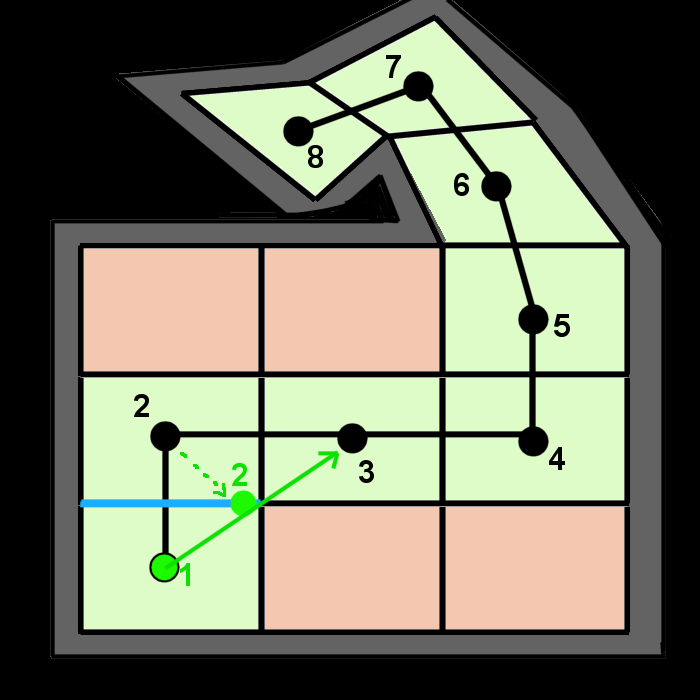
So I thought of something else, a bit different than you may have red about smoothing your pathlines with beziers/splines. We move our nodes –within their original polygons(!)- to generate a optimized path. A shorter, more natural path, but without ever leaving the original found (green) polygons. Yeah.

I'm not a math-miracle, so it's all based on simple common-sense, which is a good thing, I think. We start at Node1. But instead of moving to Node2, we already try to shortcut, directing towards Node #3:
To avoid skipping the Quad Node2 was placed on, we have to respect the blue Edge and cross it, thus getting through that quad. So Node2 gets placed on that blue edge, but as close as possible to Node3 (and note I shift it a bit back from the very corner). Now repeat the step; we displace Node3, as we try to find the shortest route from Node2 to #4:
Note how the turns get a bit more curvy at the quad corners as well. At some points, the arrow is going to intersect forbidden territory (open space or reddish quads we didn't enlist in our original search). Whenever that happens, shift the intersection point back on the edge. That's all really. I didn't try it yet, but possibly you can smooth a bit further by repeating the whole procedure 1 or more times. So in pseudo code:

for i=0 to nodeCount-3
    // Get the quad our original node was placed on
    quad = nodes[i].quad 

    // Find out via which of the 4 edges we are leaving this quad, to the next node
    edge = nodes[i].crossingEdgeToNextNode
    e1 = edge.cornerA
    e2 = edge.cornerB

    // Make a virtual line between the current point, and the node AFTER the next one
    p1 = nodes[i].pos
    p2 = nodes[i+2].pos

    // Check out where we (virtually) intersect - be aware this point may be off the edge-ends!!
    // Big Thank you Darel Rex Finley for some math & code: http://alienryderflex.com/intersect/

    if ( linesIntersectExtrapolate( e1,e2, p1,p2, @intersectionPoint ) then
        // In case the intersectionPoint was "outside" the edge, move it back inwards,
        // and stay a bit away from the outer corners

        shiftedPoint = lineShiftPointBetweenEnds( intersectionPoint, e1,e2, 0.01 )

        // Store in the NEXT node pos - so the next loop iteration will calculate from taht point onward
        nodes[i+1].pos = shiftedPoint
    end
next

The final result is a lot better than the original, though it may still take some sharp turns here and there. I “fixed” that dynamically, by letting the character "physics" turn with some delay and speed decreasement, instead of stopping and taking a perfect turn. Like a car on mud, getting off-road a bit. Only on very sharp turns the character actually stops, takes a different "rotation animation", and turns. As you would do yourself when taking a sudden turn. In other words, the line is not a 100% strict guider.


Sunday, November 6, 2016

The Unpredictables


Last time we talked about a Navigation Mesh; basically telling your A.I. where the dancefloor is. Pathfinding algorithms and navigationmeshes are all tools to help finding your way in a big bad game world. All in all, very common Game-Programming stuff.

Less common in the tutorial newspapers, is the decission-making part. We have a car, we have asphalt, we have a navigator, but yet – destination unknown. Whether its David Hasselhoff, KITT, or captain Picard, something has to drive that car. This is where we enter the fuzzy parts of A.I. And also personal unknown territory. I programmed a lot of machine regulators, graphics, and “axuiliary” game-stuff (read engine architecture, loaders, physics, scripting systems, navigation algorithms, and so on). But not so much of an actual game-logic itself so far. Like building a new house, but never finished it till the point we can do the interior and start living in it.

Game-logic typically covers the rules of a game. What are the goals? When do you win, when do you lose? And on a more detailed level, it covers puzzles, interaction, scoreboards, inventories, pre-programmed scripts, player-controls/physics, and also foe-controls; A.I. Varying from Pac-Man ghosts chasing you, to Carmageddon race-cars trying to trash you. From Goomba’s walking from right-to-left, to bionic supersoldiers trying to pin you down. Obviously, deciding where to go, when to go, and how to get there, is a crucial part of A.I. And like I said, a rather fuzzy one.


Predictable patterns
When making a piece of machine-logic, the word “random” is forbidden. Depending on the given parameters, the outcome of a subsystem should be 100% predictable. It would suck pretty hard if your car randomly decides to start yes or no, when turning the ignition key. When not doing so, there should be a damn good reason for it, not just for the fun of it.

Well, common sense, but game-A.I. breaks the rule here. If your opponent would always react exactly the same, the game would become, well, very predictable. Not only would it make the game too easy, it also makes your opponents appear very “synthetic”. But hey, thank God we have a random() function! But - be careful! Too much randomness will spoil your diner as well. You don’t wake up, put on a single green sock, shit out the window, step naked in the car, drive backwards through the garage-door, call your neighbor a lunatic, boil applejuice with fish, then get back in bed again. Our human behavior is, more than you may like, pretty predictable. I for instance always put on 2 socks, shit out the window, drive naked to work in reverse, and drink my first coffee at nine A.M.. However, there are subtle “random” differences in the execution. Sometimes I mix up socks accidentally, and sometimes I drink my coffee at 9:05 instead.

You’ll need some predictable (pre-programmed) patterns to make your NPC’s act human. And some predictableness also helps making you feel good as a player, learning the responses, flaws and weaknesses of your foes. Personally I’m not a fan of MultiPlayer gaming, because the lack of that “Damn I’m good” feeling. I keep dying, as some asshole caught me from behind, or randomly crossed paths and reacted slightly faster. Just like the real deal… One moment you’re storming upon a beachhead, next moment Heinz Panzerfaust floors you with a headshot. One moment Nancy Sinatra sings your boots are made for walking, next moment you tumble in a hole with Punji Sticks, pissed on by Ho Chi Minh. One moment you’re humming in a Humvee, next moment an IED shreds it apart. Fun. Not.


When I play a game, I generally don’t want a superrealistic experience, dying ingloriously. I want to kick ass. Doesn’t mean the game should be easy, certainly not. But dying should feel fair, not like random bad luck. And yeah, that sounds a bit ridicously, as real-life war is verything but fair. But hey, we’re playing a game. To have fun. Getting killed means I made a mistake; Lick my wounds, learn, and try again. If your NPC logic is very unpredictable (read random), you can’t really learn and act on it.

So, A.I. needs to be fuzzy and unpredictable, but only to a certain extend (unless you’re making bots for Battlefield1… anyone?! Please!). In programming terms, that feels a bit unnatural. Always doing the same won’t work, completely random picking doesn’t work either. What also feels unnatural is that your code has to pretend “as if”. Game NPC’s don’t have real eyes or ears, and they can cheat all the time. They always know exactly where the player is, they can aim their guns 100% accurate, dodge lightning bolts, and respond within a millisecond. We cover that up with some random inaccuracies and delay timers, but that has little to do with how a brain really works.

No. Picture has nothing to do with this topic. Just some empty rooms, and I'm afraid they'll stay empty for a little while now that noone is working on graphics or texture/3D content at the moment.

 
Are we Human? Or are we Monsters?
Well, my job last week(s) was to program some of those “Behavior Patterns”. Thanks to A* and a navigationmesh, getting from A to B was relative easy. Deciding what “B” would be on the other hand… I mean, where does a monster go? In a Soviet-like skyscraper? To the bathroom? To the conference room? To his friends? And then doing what?

Back in the day, monsters just had to growl a bit and wait until the player showed up. Then jump at him and probably getting shot while doing that. Not exactly a brilliant role in the school’s play. But nowadays we want realism, meaning foes have to make themselves useful in this virtual world. Whether sleeping, cooking soup, repairing the generator or just being on the move – at least do something. But obviously that’s pretty hard for a monster. They have to be scary, not driving their cars to work, drink beer and watch football, or repair the generator. Hell, some of my monsters don’t even have arms for that!

The good news though, you will only see a little bit of that “Idle” behavior. More likely you should avoid monsters, or end up either running or fighting with them. Unless your monster carries an AK47 or plasma projectiles, the second best choice is probably to just charge at you, meaning their destination location will be you. So far, so good; Monster angry, monster runs at you, Benny-Hill music, player flees, and then… Player out of sight. Now what?


Room service
Let’s say the player ran a few rooms further, and hides under bed, as I would do. This is a perfect scenario to show predictibility, artificial smartness, or straight dumbness of your foes. For one thing, he could keep walking straight to the player position. But that would be cheating of course. Slightly less cheating would be to enter at least the bedroom, then act as if we’re sniffing and searching the room. But if our monster would do that every time, it would be –exactly- predictable.

Then again picking a random target-point as soon as the player runs out of sight, would be plain stupid. Chances that he’ll find you are nihil then, plus it doesn’t feel like a logical response at all. In fact, I’ve been training my pet-Monster in Tower22 a lot of times last two weeks, doing exactly this. I would run away about 15 meters, hide under a table, then *hope* to see my monster-friend searching nearby rooms. But of course he would take a wrong pick, and I had to come from under the table, and start making noise and yell “Come here dumbass! I’m here! Look!”.

I won’t reveal the exact methods, as this pre-knowledge would ruin the fun of future players, but let’s say our guy finally learned some better “Room-Sweeping” methods. Picking the right directions (at the start of the search at least), searching room by room, not using cheap cheats but “real” vision and acoustic information. Only problem is… I trained my pet so many times now, that his behavior is still preditable. To me at least. But that’s why they invented “Beta Tasters”…

And if hiding doesn't work, I just finished some code to throw this waterkettle at somebody's head.